

HPPE vs Aramid Cut Resistant Gloves: Heat Resistance & Industrial Application Guide
Oct 26, 2026
Leave a message
What each material actually is
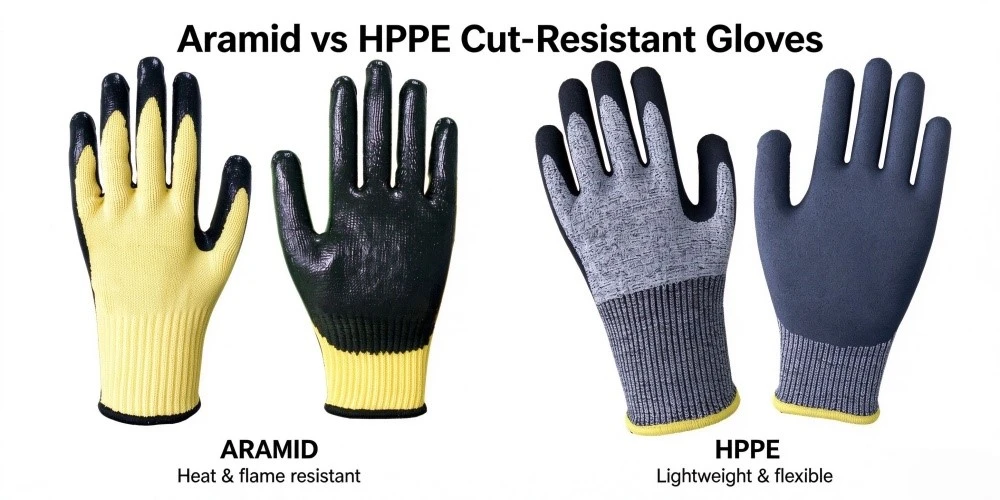
HPPE (high-performance polyethylene, or UHMWPE) is a gel-spun polyethylene fiber. It's one of the strongest fibers per unit weight there is - that's why it's used in ballistic vests as well as gloves. In a glove liner it gives you:
- Very high cut resistance at a light weight
- Excellent flexibility and touch sensitivity
- Great moisture wicking and comfort
- Low cost per pair
Polyethylene is a plastic. Above roughly 130°C (266°F) it softens and melts. It's not flame-resistant on its own and can't be used around sustained heat.
Para-aramid (sold as Kevlar®, Twaron®, and generically as aramid) is an aromatic polyamide with a rigid, highly oriented molecular structure - tensile strength roughly five times that of steel at equal weight. What matters for heat work:
- Does not melt. It starts to decompose around 400–500°C, and in practice gloves hold up to 250–350°C continuously and 400°C+ in short contact (EN 407 contact heat level 3 territory).
- Inherently flame-resistant - won't melt, drip, or propagate flame.
- Good cut and abrasion resistance, plus resistance to heat and chemicals.
Heavier, less dexterous, and noticeably more expensive than HPPE.
Heat resistance - the head-to-head you actually need
| Property | HPPE / UHMWPE | Para-aramid (Kevlar) |
|---|---|---|
| Melting / decomposition point | Melts ~130°C | Doesn't melt; decomposes 400–500°C |
| Continuous heat use | Not recommended above ~80–100°C | Up to 250–350°C |
| Brief contact heat | Avoid | Up to ~400°C (with coatings, more) |
| Flame behavior | Melts / drips | Self-extinguishing |
| Cut resistance | Very high | High |
| Dexterity / comfort | Excellent | Good |
| Abrasion resistance | Excellent | Good |
| Typical cost | Low | Moderate–high |
One important caveat: aramid's raw cut rating is usually below a top-end HPPE liner. So aramid is rarely the best cut-value-per-dollar pick on cold work. Its value is the combination of cut plus heat protection - that's the niche HPPE cannot touch.
Cut ratings you'll see on both
Both fibers get graded under the same two systems, so compare apples to apples:
- EN 388 (EU): the Coup test gives cut 1–5; the 2024 update adds a TDM blade test rated A–F (A is lowest, F the highest force).
- ANSI/ISEA 105 (US/Canada): the straight-blade test gives A1–A9 cut levels.
- A typical mid-range HPPE liner sits around EN388 Coup 5 / TDM E-F or ANSI A5–A6. Aramid liners land a bit lower on raw cut - often ANSI A3–A5 - but that's the trade you accept to get heat resistance.
- If the product sheet lists both EN and ANSI numbers, use the ANSI level for US buyers and the EN Coup/TDM for European buyers. The two scales don't convert cleanly, so don't quote them as equivalent.
Where to use each one
Go with HPPE when the job is sharp and cold:
- Handling sheet metal, stamped edges, and formed metal parts
- Glass handling, cutting, and assembly (cold glass, not furnace work)
- Recycling and scrap sorting
- General assembly, warehousing, logistics, and material handling
- Metal stamping, machining, and light fabrication
- Any task where touch sensitivity and all-day comfort matter more than heat
Go with aramid when heat is part of the picture:
- Foundries, casting, and smelting - handling near molten metal
- Glass and ceramics manufacturing (furnace, hot molds, freshly formed product)
- Welding - aramid liners under leather, or coated aramid for splatter
- Automotive and exhaust work - handling hot components
- Fire and rescue support tasks, and any job near open flame or radiant heat
- Oven, kiln, and heat-treatment operations
If you can't comfortably hold the workpiece in a bare hand, HPPE is already wrong. That's a heat job, so it needs aramid (and possibly a heat coating on top).
Blended liners and coated gloves - the practical middle ground
Pure aramid for heat plus HPPE for comfort is a real product category: HPPE/aramid blends (often called "composite" or "Dyneema-style + aramid" liners) combine the two yarns in one glove. You get:
Higher cut levels than aramid alone
Better heat tolerance than HPPE alone
A compromise on comfort and cost between the two
For hot-and-sharp work - like automotive assembly or metal processing where parts come off hot and have sharp edges - a blend is often the smarter buy than pure aramid, because it fixes the main weakness (raw cut level) without losing the heat protection.
And don't ignore coatings: nitrile or PU dips add grip and some splash/abrasion resistance; a heat-resistant coating (or aluminized surface for radiant heat) upgrades aramid's already-good thermal performance for foundry and smelting work.
pick by the risk, not the spec sheet
Cold + sharp → HPPE. Best cut value, lightest, most comfortable.
Hot + sharp → aramid or an HPPE/aramid blend. Accept a lower raw cut level to get heat survival.
Hot + molten/radiant → aluminized aramid or aramid under leather - beyond what a bare knit liner can do.
Always cross-check the glove's EN388 cut level and, if heat is claimed, its EN 407 contact-heat rating against the actual temperature and sharpness on your line.
If you're sourcing and aren't sure, send the job's max temperature and the sharpest edge workers touch - that's enough to shortlist the right glove in one pass.
Send Inquiry