

What Are Cut Resistant Gloves? A Practical Guide to Materials, Cut Levels and Applications
Aug 11, 2026
Leave a message
Cut resistant gloves are designed to reduce hand injuries caused by sharp edges, blades, sheet metal, glass and other cutting hazards. Their performance depends on more than the liner material: yarn construction, coating, glove thickness, fit and the location of reinforcement all affect how the glove works in practice.
For safety managers and PPE buyers, the main challenge is not finding the highest cut rating. It is selecting a glove that provides enough protection without making the hand unnecessarily stiff, hot or difficult to use.
What Does "Cut Resistant" Actually Mean?
A cut resistant glove is not cut-proof. It is engineered to delay or reduce blade penetration under defined test conditions.
The marked cut level gives buyers a standardized way to compare products, but it does not guarantee protection against every sharp object. A thin sheet-metal edge, a utility knife and a rotating blade create very different hazards. The pressure, direction of movement and duration of contact also change the risk.
This is why glove selection should begin with the actual task:
What type of sharp edge will the worker handle?
Is contact occasional or continuous?
Does the job also involve abrasion, puncture or impact?
Will the glove be used in dry, oily or wet conditions?
How much finger movement does the operator need?
Which certification system applies in the target market?
A glove that performs well in a laboratory test can still be unsuitable if its grip, sizing or coating does not match the workplace.
How Cut Resistant Gloves Are Made
Most modern industrial cut resistant gloves use a seamless knitted liner. The liner may contain one fiber or a blend of several yarns, depending on the required protection level, flexibility and cost.
After knitting, the glove may be left uncoated or dipped in polyurethane, nitrile, sandy nitrile, foam nitrile or latex. The coating changes the grip, abrasion resistance and liquid resistance of the finished glove.
Some products also include localized reinforcement between the thumb and index finger or along a high-wear area. This can extend service life without adding unnecessary bulk to the whole glove.
A well-designed glove balances four things:
Cut protection
Dexterity
Grip
Durability
Increasing one does not automatically improve the others. A heavier liner may increase protection but reduce fingertip control. A thick coating may last longer but make small-component handling more difficult.
Common Materials Used in Cut Resistant Gloves

HPPE
High-performance polyethylene, commonly called HPPE, is widely used in lightweight cut resistant gloves. It offers a high strength-to-weight ratio and can be knitted into thin, flexible liners.
HPPE gloves are commonly selected for:
Metal assembly
Glass handling
Construction
Warehousing
Automotive work
General industrial maintenance
HPPE feels relatively cool and smooth compared with heavier traditional fibers. For moderate and high cut levels, it is often blended with glass fiber, steel or other reinforcement yarns.
The final rating should always be confirmed through testing of the complete glove. Two liners both described as "HPPE" may produce very different results because their yarn composition, knitting density and coating are not the same.
Aramid Fiber
Aramid fibers are known for heat resistance, strength and resistance to cutting. They are commonly used in work gloves for metal handling, welding support work, foundries and applications where both mechanical protection and heat exposure must be considered.
Aramid liners generally tolerate heat better than HPPE. However, the exact contact-heat performance depends on the complete glove construction, including liner thickness, coating and any internal insulation.
Aramid is also used in sleeves and heavier thermal gloves. It can be combined with cotton to improve comfort or with other reinforcement fibers to increase mechanical performance.
Glass Fiber
Glass fiber is often added to HPPE or synthetic yarn blends to raise cut resistance without making the glove excessively thick.
Because glass fiber is normally used inside a blended yarn, the wearer should not be in direct contact with exposed filaments. Yarn quality and knitting control are important. Poor construction can create irritation, fiber breakage or inconsistent glove performance.
Glass-reinforced liners are common in medium- and high-level cut resistant gloves, particularly when buyers need a practical balance between protection and price.
Stainless-Steel Fiber
Fine stainless-steel fiber can be blended into a knitted liner to achieve higher cut resistance. It is different from the stainless-steel ring mesh used in butcher and food-processing gloves.
Steel-reinforced knitted gloves are suitable for demanding industrial work, but the design must still account for comfort and flexibility. More metal content does not automatically make a better glove. An overly rigid liner can increase hand fatigue and reduce compliance among workers.
Nylon and Polyester
Nylon and polyester are not normally the main cut resistant components in a high-performance glove. Instead, they are often used as carrier yarns to improve fit, surface quality, durability and knitting stability.
They can also help create a smoother liner that is easier to coat consistently.
Understanding EN 388 Cut Resistance Levels
EN 388 is the main European standard used to evaluate gloves against mechanical risks. A typical EN 388 marking contains several numbers and letters.
For example:
4X43D
The positions represent:
Abrasion resistance
Coupe blade-cut resistance
Tear resistance
Puncture resistance
ISO 13997 cut resistance
Optional impact protection marking
The ISO 13997 cut result is shown as a letter from A to F:
| EN 388 Level | Cutting Force |
|---|---|
| A | 2 N |
| B | 5 N |
| C | 10 N |
| D | 15 N |
| E | 22 N |
| F | 30 N |
A higher letter means that more force was required to cut through the test specimen.
The older Coupe test is still shown in many EN 388 markings, but it may be reported as "X" when it is not used or when the glove material dulls the circular test blade. For high-performance cut resistant materials, the ISO 13997 result is usually the more useful figure for comparison.
A Cut D glove is not automatically better for every task than a Cut C glove. If the job requires high fingertip sensitivity and only moderate exposure to sharp edges, the lighter glove may be the more practical choice.
Understanding ANSI/ISEA 105 Cut Levels
The ANSI/ISEA 105 system is widely used in the United States and classifies cut resistance from A1 to A9.
| ANSI Cut Level | Cutting Load |
| A1 | 200–499 g |
| A2 | 500–999 g |
| A3 | 1,000–1,499 g |
| A4 | 1,500–2,199 g |
| A5 | 2,200–2,999 g |
| A6 | 3,000–3,999 g |
| A7 | 4,000–4,999 g |
| A8 | 5,000–5,999 g |
| A9 | 6,000 g or more |
A1–A3 gloves are generally considered for lighter cutting hazards and general handling. A4–A6 products cover many construction, glass, automotive and metalworking applications. A7–A9 gloves are intended for more severe cutting hazards.
These examples are only a starting point. The employer or safety manager should assess the actual hazard before selecting a level.
The EN and ANSI systems should not be converted by simply matching a letter with a number. They use different rating structures. When a glove is intended for both European and North American markets, it is better to test and report it under both relevant systems.
Why the Palm Coating Matters
The liner provides most of the cut resistance, but the coating determines how the glove interacts with the object being handled.
PU Coating
Polyurethane creates a thin palm surface with good dexterity and relatively low bulk. It is frequently used for dry handling, assembly, inspection and small metal components.
PU-coated cut resistant gloves are a common choice when fingertip control is more important than liquid resistance.
Foam Nitrile
Foam nitrile offers a balance of grip, flexibility and abrasion resistance. Depending on its formulation and surface finish, it can work well in dry or lightly oily environments.
It is widely used for automotive assembly, machinery work, metal fabrication and general maintenance.
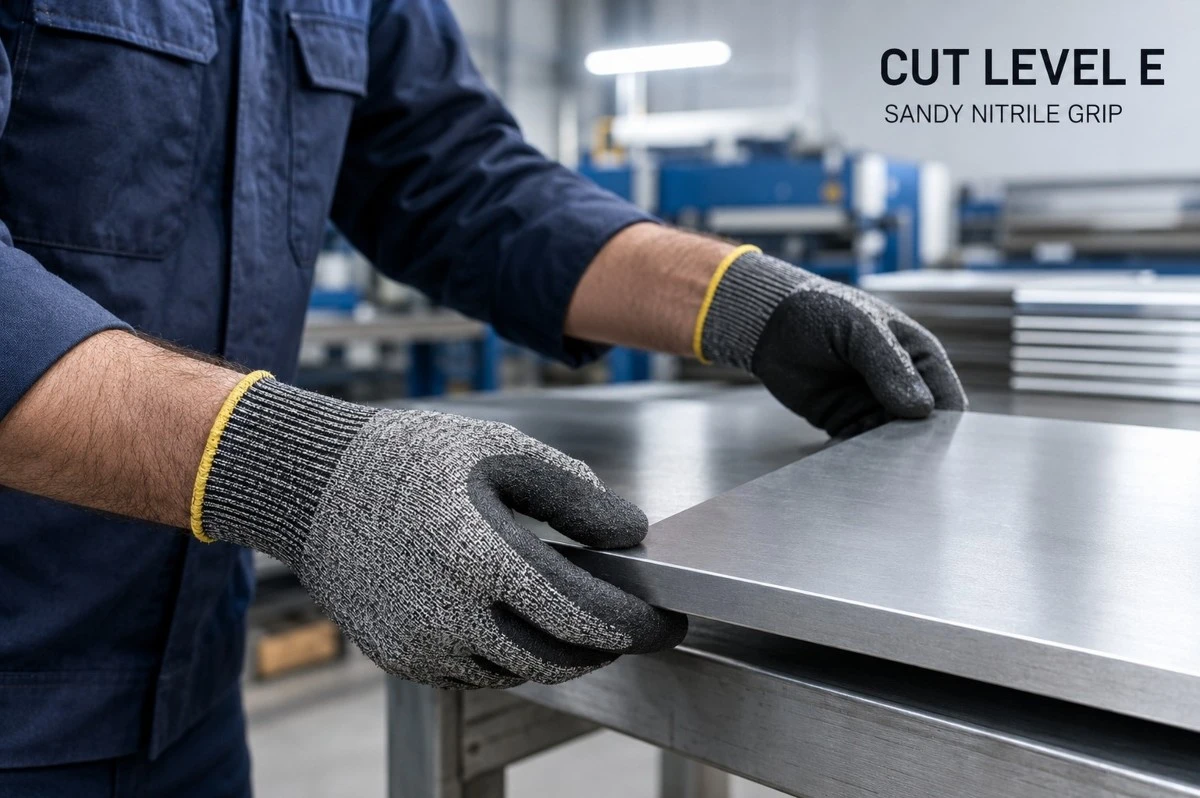
Sandy Nitrile
Sandy nitrile has a textured surface designed for more demanding grip conditions. It is often selected for oily metal, construction materials and heavier components.
The coating is generally more robust than a very thin PU finish, although it may feel slightly heavier.
Smooth Nitrile
Smooth nitrile provides stronger surface coverage and better resistance to oils than many breathable foam coatings. It can be useful where the palm requires more protection from dirt, grease or limited liquid contact.
It is important to distinguish oil resistance from full chemical protection. A standard nitrile-coated work glove should not be marketed as a chemical-resistant glove unless it has been tested to the relevant chemical protection standard.
Latex
Latex coatings provide strong dry and wet grip and are commonly used in construction, glass handling, recycling and general material handling.
Latex may be less suitable where oil contact is frequent. Buyers should also consider latex sensitivity and any market-specific material requirements.
Choosing the Correct Glove Gauge
Gauge refers to the knitting density of a seamless glove liner. A higher gauge generally uses finer yarn and creates a thinner, more closely fitted glove.
Common constructions include:
10 gauge for heavier, thicker gloves
13 gauge for general industrial protection
15 gauge for improved flexibility
18 gauge for fine handling and fingertip sensitivity
Gauge alone does not determine the cut level. An 18-gauge glove can provide high cut resistance when made with an advanced yarn blend, while a thicker glove made from basic fibers may offer much less protection.
For buyers, gauge is mainly useful for understanding the expected feel, thickness and dexterity of the product.
Cut Resistance Is Only Part of the Specification
Many industrial tasks expose workers to several hazards at the same time. A complete glove specification may also need to cover:
Abrasion resistance
Tear resistance
Puncture resistance
Impact protection
Contact heat
Cold protection
Oil grip
Water resistance
Electrostatic properties
Food contact requirements
For example, workers handling stamped sheet metal may need cut resistance, abrasion resistance and an oil-grip coating. Glass workers may need cut protection plus strong wet grip. A glove used around heated components may require both EN 388 and EN 407 testing.
Listing only the cut level can result in the wrong product being supplied.
Typical Applications

Sheet Metal and Fabrication
Sharp edges, burrs and repeated friction make cut protection essential. Foam nitrile or sandy nitrile coatings are often used where sheets or components carry light oil.
Glass Handling
Workers need reliable grip as well as cut resistance. The coating must suit dry or wet glass without becoming too rigid.
Automotive Assembly
Automotive work often combines sharp parts, oily surfaces and repetitive finger movement. Thin HPPE liners with nitrile coatings are commonly used to maintain dexterity.
Construction
Cut hazards can come from metal profiles, tiles, glass, cable and rough building materials. The glove must also withstand abrasion and outdoor handling.
Warehousing and Logistics
Some warehouse tasks involve cartons, strapping, damaged pallets and sharp packaging edges. Lower or medium cut levels may be sufficient, depending on the products being handled.
Recycling and Waste Sorting
Unidentified sharp objects create a less predictable risk. Higher cut and puncture protection may be required, together with a durable coating.
Food Processing
Knife work may require specialized cut resistant gloves or stainless-steel mesh gloves. Materials and finished products may also need to meet applicable food-contact requirements.
Common Buying Mistakes
Selecting the Highest Rating Without Considering Dexterity
A high cut level may look safer on paper, but an unnecessarily heavy glove can reduce control and increase hand fatigue. Workers may remove an uncomfortable glove, which defeats the purpose of specifying it.
Comparing Gloves by Material Name Only
"HPPE glove" is not a complete specification. The buyer should check the tested performance level, gauge, coating, cuff, weight, sizes and intended application.
Assuming One Test Report Covers Every Similar Model
Changes to yarn composition, coating, glove gauge or construction can affect test results. Documentation should correspond to the product being supplied.
Ignoring Grip Conditions
A glove with the correct cut rating may still be unsafe if workers cannot hold oily, wet or smooth parts securely.
Ordering Without Wear Trials
Laboratory results are necessary, but workplace trials reveal fit, grip, durability and comfort issues that may not appear in a datasheet. Testing several pairs in the actual application is usually worthwhile before placing a large order.
OEM Cut Resistant Gloves from Nexprotec
Nexprotec manufactures seamless knitted work gloves for industrial PPE brands, distributors and importers. Available constructions include HPPE, aramid and reinforced yarn liners with PU, nitrile, foam nitrile, sandy nitrile or latex coatings.
We support private-label projects involving:
Target cut performance
7-, 10-, 13-, 15- and 18-gauge knitting
Custom liner and coating colors
Palm-dip, three-quarter-dip and full-dip coatings
Printed logos and sewn labels
Thumb-crotch or localized reinforcement
Custom retail and bulk packaging
Sample development before production
The required performance should be confirmed through testing of the final glove construction. For projects requiring EN 388 or ANSI/ISEA 105 documentation, the test scope and certification route can be reviewed after the product specification is fixed.
Frequently Asked Questions
1. Are cut resistant gloves completely cut-proof?
No. Cut resistant gloves reduce the risk and severity of cuts, but no textile glove can guarantee protection against every blade or cutting action.
2. What is the difference between EN 388 Cut D and Cut E?
Under the ISO 13997 test, Cut D requires a cutting force of 15 N, while Cut E requires 22 N. Cut E therefore represents a higher tested resistance, but it may require a heavier or more reinforced liner.
3. Which cut level is suitable for sheet-metal handling?
The correct level depends on edge sharpness, part weight, frequency of contact and handling method. Many applications use medium-to-high cut protection, but the final choice should follow a workplace risk assessment and trial.
4. Are HPPE gloves suitable for hot objects?
Standard HPPE is mainly selected for mechanical protection, not high-temperature contact. If heat is present, consider an aramid-based construction and verify the finished glove under the relevant heat-protection standard.
5. Which coating is best for oily metal?
Foam nitrile and sandy nitrile are common choices. The better option depends on how much oil is present and how much dexterity the task requires.
6. Can an 18-gauge glove provide high cut resistance?
Yes. Fine-gauge gloves can reach relatively high cut levels when they use advanced reinforced yarns. The test report, rather than gauge alone, confirms the performance.
7. Can a logo be added to a certified glove?
A printed logo or sewn label is often possible, but any modification should be reviewed against the certification and marking requirements. Changes to the protective construction are more significant than packaging or branding changes.
8. Should samples be tested before a bulk order?
Yes. An application trial helps confirm fit, grip, comfort, durability and finger movement under real working conditions.
Discuss Your Cut Resistant Glove Project
Send us your required cut level, coating, gauge, sizes, application and target order quantity. Nexprotec can review the specification, develop samples and recommend a practical glove construction for your OEM or private-label project.
Contact Nexprotec to request samples or discuss a custom cut resistant glove program.
Send Inquiry