

ANSI A5 Vs EN 388 Level E Cut Resistant Gloves
Aug 03, 2026
Leave a message
It is common to find "ANSI A5 / EN ISO E" printed together on an industrial glove. The two ratings sit in a similar performance range, but they come from different standards and should not be treated as interchangeable labels.
ANSI A5 belongs to the North American ANSI/ISEA 105 system. Level E belongs to the ISO 13997 section of the European EN 388 standard. A glove sold with both markings should have test evidence for both claims.
The Short Answer
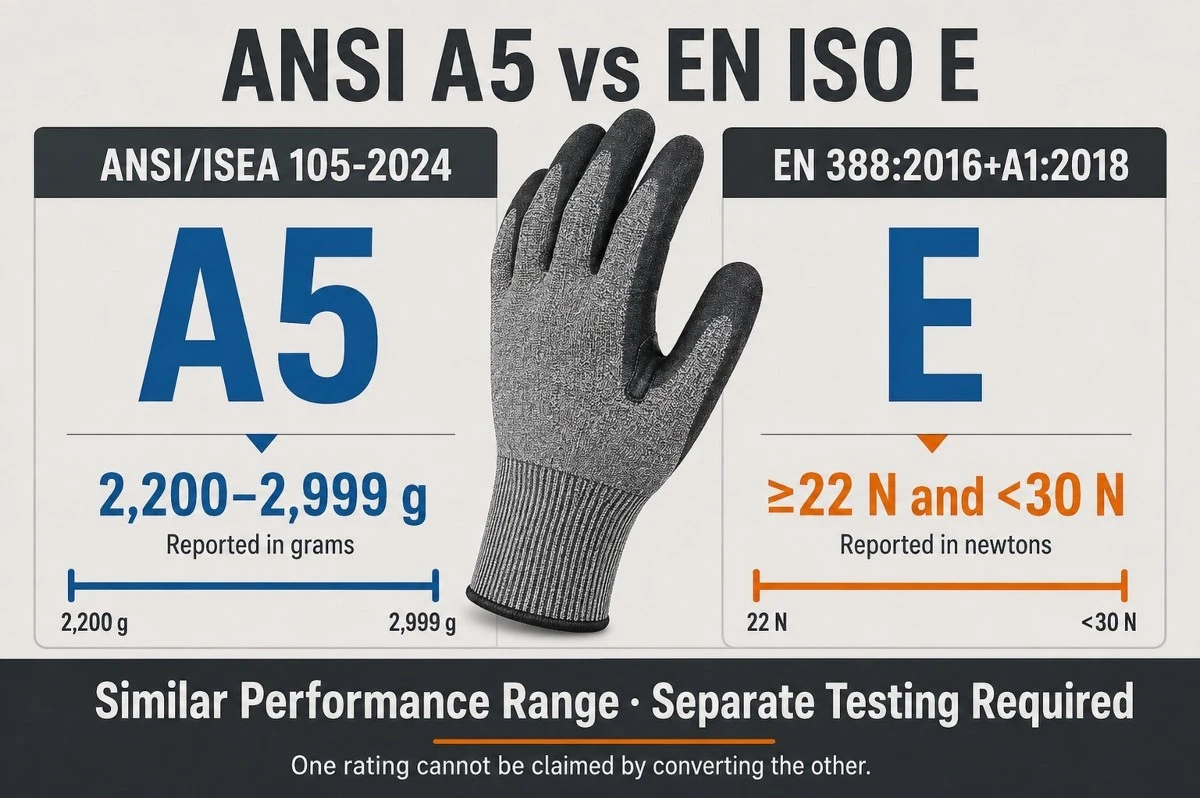
ANSI A5 requires a cut-through result between 2,200 and 2,999 grams under the ANSI/ISEA classification.
EN 388 Level E requires at least 22 newtons under ISO 13997. Level E continues up to the threshold for Level F, which begins at 30 newtons.
The numbers are close after unit conversion, which explains why many gloves achieve both ratings. However, mathematical conversion does not replace testing under the required standard.
| Rating | Standard | Reported result |
|---|---|---|
| ANSI A5 | ANSI/ISEA 105-2024 | 2,200–2,999 g |
| EN ISO E | EN 388:2016+A1:2018 | ≥22 N and below Level F |
| Next higher level | ANSI A6 / EN ISO F | A6 begins at 3,000 g; F begins at 30 N |
The current ANSI/ISEA 105-2024 system uses nine cut levels from A1 to A9. EN 388 uses ISO 13997 letters from A to F for its straight-blade cut result. ANSI overview, uvex EN 388 guide
What Does ANSI Cut Level A5 Mean?
ANSI/ISEA 105 is widely used for industrial hand protection sold in the United States and other North American markets.
The cut test uses a straight blade moving across the material under controlled loads. The result is reported in grams. A glove classified as ANSI A5 records a result from 2,200 to 2,999 grams.
A5 is frequently specified for work involving:
- Sheet-metal handling
- HVAC installation
- Metal fabrication
- Glass processing
- Automotive production
- Machinery maintenance
- Handling sharp or rough components
- Construction work involving metal edges
The A5 marking refers to cut-test performance. It does not automatically describe abrasion, puncture, impact, grip or chemical resistance.
What Does EN 388 Level E Mean?
Under EN 388:2016+A1:2018, ISO 13997 cut resistance appears as the fifth performance position beneath the mechanical-risk pictogram.
For example:
4X42E
In this marking:
4 indicates abrasion resistance
X means the Coupe blade-cut result is not reported or is not applicable
4 indicates tear resistance
2 indicates puncture resistance
E indicates the ISO 13997 cut level
Level E begins at 22 N. The ISO 13997 method determines the force needed for a straight blade to cut through the glove material over a 20 mm distance.
The test result applies to the area tested, normally the palm material. It should not be read as proof that the cuff or back of the hand offers the same protection.

Are ANSI A5 and EN ISO E Equivalent?
Not officially.
A force of 22 N is approximately equal to 2,243 grams-force, which falls inside the ANSI A5 range. This numerical overlap is why a properly constructed glove may receive both A5 and E ratings.
That does not mean a buyer can convert one result and print the other marking.
ANSI and EN claims belong to separate testing and documentation systems. Test reports, product markings and market compliance must follow the requirements of the intended destination.
A current Ansell glove, for example, carries both ANSI/ISEA 105-2024 A5 and EN ISO E markings because the product is supported for both standards-not because one label was automatically converted into the other. Ansell dual-rated glove example
Why Dual Ratings Matter for International Buyers
A distributor selling the same glove in the United States and Europe may prefer one construction supported by both test systems.
This can simplify:
- Product-range management
- Customer specification sheets
- Sales-team training
- International packaging development
- Stock planning across markets
- Tender documentation
The advantage only applies when the reports and product markings are properly managed. A packaging designer should not add ANSI A5 or EN ISO E simply because the liner uses a similar yarn to another certified glove.
Even a change in coating, liner weight, reinforcement fiber or knitting structure may affect the finished result.
What Construction Can Reach A5 and Level E?
There is no single material formula.
A5/E cut-resistant gloves may use HPPE, aramid or other engineered yarns combined with reinforcement materials such as steel, glass, basalt or tungsten. Nylon, polyester and spandex may be added to improve fit and knitting performance.
The finished glove can be produced in different gauges:
- 13 gauge: More substantial feel with room for reinforced yarns
- 15 gauge: A middle ground between protection and dexterity
- 18 gauge: Finer construction for handling smaller components
Modern yarn development has made thinner high-cut gloves possible, but gauge alone does not determine the cut level. A lightweight 18-gauge glove can outperform a thicker glove if its yarn structure is better engineered.
Coating Selection Still Matters
Once the required cut level is fixed, the palm coating should be selected for the work environment.
PU Coating
A thin PU palm is often used for dry assembly, inspection and precision handling. It keeps the glove relatively light and allows good fingertip control.
Foam Nitrile
Foam nitrile provides more grip where components carry small amounts of oil. It is commonly selected for automotive, machinery and fabricated-metal work.
Sandy Nitrile
A sandy finish has a coarser surface for handling rough or oily materials. It normally feels heavier than a PU-coated glove.
Smooth Nitrile
Smooth nitrile offers more complete surface coverage and may suit jobs where oil resistance and coating durability are priorities.
An A5/E liner with the wrong coating can still perform poorly in the workplace. A glove that slips on an oily component may introduce a handling risk unrelated to its cut rating.
What Should Appear on the Test Report?
Before approving a dual-rated glove, buyers should check:
- Full product or model identification
- Tested glove construction
- Applicable test standard
- Laboratory information
- Individual performance results
- Report date
- Glove size used for testing
- Photographs or material description
Relationship between the tested sample and ordered product
For EN 388 projects, the complete mechanical-risk marking should be reviewed. For the US market, buyers should confirm that the ANSI claim follows the required A1–A9 format.
If a private label version changes the material construction, the existing report may no longer cover it.
OEM A5 and EN ISO E Glove Development
Nexprotec can prepare dual-market cut-resistant glove samples for PPE brands, importers and industrial distributors.
Options include:
- 13-, 15- or 18-gauge liners
- HPPE or aramid-based yarn structures
- Reinforcement-fiber selection
- PU, foam nitrile or sandy nitrile coating
- Thumb-crotch reinforcement
- Touchscreen fingertips
- Custom sizes and colors
- Back-of-hand printing
- Woven labels and private label packaging
Samples normally require around 7–15 days after the construction is confirmed. Where the selected model does not already have the required reports, the approved finished glove can be submitted for ANSI and EN 388 testing before bulk packaging is printed.

Frequently Asked Questions
Can an EN ISO E report be used to claim ANSI A5?
No. The numerical ranges overlap, but the ANSI claim requires suitable testing and documentation.
Is A5/E suitable for every metalworking job?
No. The rating may suit many fabrication tasks, but the risk assessment must also consider pressure, edge sharpness, puncture, oil, heat and impact.
Does a thicker glove always have a higher rating?
No. Yarn engineering and reinforcement materials have more influence than thickness alone.
Can the coating be changed after testing?
A coating change can affect the finished glove and its test status. The final construction should be confirmed before certification and packaging approval.
Request a Dual-Rated Cut-Resistant Glove Sample
Send Nexprotec your target market, required cut level, liner gauge, coating, sizes and estimated quantity. We can prepare the glove construction for evaluation and arrange ANSI/ISEA 105 and EN 388 testing after sample approval.
Send Inquiry