

Factories Are Adding More Robots. The Work Glove Is Getting Thinner
Aug 18, 2026
Leave a message
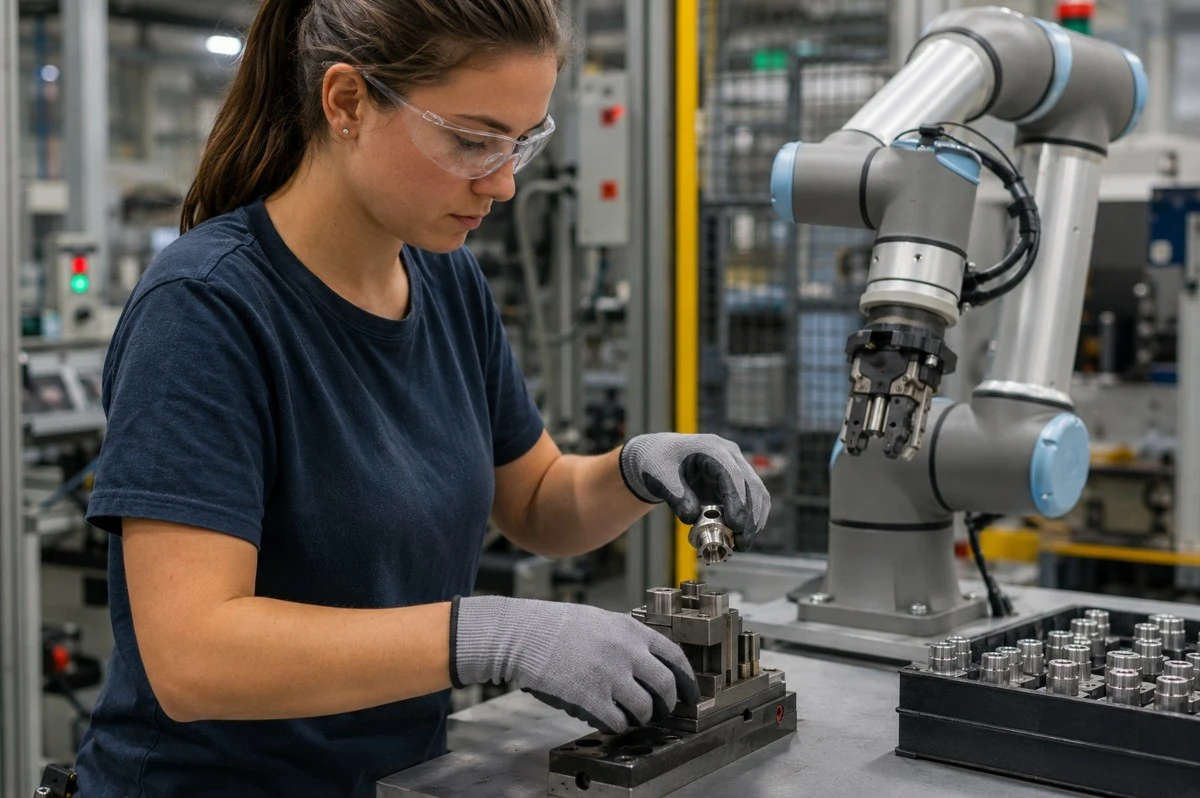
A robot can weld the same joint all day without tiring. It can lift a component, place it within a fraction of a millimeter and repeat the cycle thousands of times. Yet somewhere beside that robot, a person is usually loading an unusual part, checking a surface defect, changing a fixture or dealing with the job that did not go as planned.
Automation has not taken human hands out of manufacturing. It has changed what those hands do.
That change is beginning to show up in glove specifications. Factories still need cut, abrasion and grip performance, but many buyers are now asking for those properties in a thinner, closer-fitting glove that can handle small parts, touchscreens and short inspection tasks without being removed.
The Numbers Explain Why This Conversation Is Growing
The International Federation of Robotics recorded 542,000 industrial robot installations in 2024-more than twice the number installed ten years earlier. The global operational stock reached approximately 4.66 million units, up 9% from the previous year. Asia accounted for 74% of new installations.
These figures do not describe empty factories. In most plants, robots operate as part of a wider system that still includes operators, technicians, quality inspectors, material handlers and maintenance teams. The robot takes over a defined movement. People manage the variation around it.
This is especially clear in automotive components, metal fabrication, electronics, appliance production and general industrial assembly. Automated cells may perform the main process, while nearby workers feed components, inspect finished parts, rework rejects, replenish materials and record production data.
Those are hand-intensive jobs. They are simply different from the heavier manual work that came before them.
Robots Handle Repetition. People Handle Exceptions.
The easiest manufacturing tasks to automate are usually consistent and predictable. Real production is neither of those things all the time.
A stamped component arrives with a sharp burr. A plastic housing sits incorrectly in a fixture. A connector needs to be reseated. A finished surface has to be checked under angled light. A label has folded over, or a fastener has started at the wrong angle. These moments are too small to dominate a production report, but they make up a significant part of an operator's day.
They also expose the weakness of a bulky glove. Extra material at the fingertips makes it harder to feel whether a clip is seated. A stiff palm coating increases the effort needed to handle small fasteners. Poor size grading leaves some workers with loose fingers and others with pressure across the knuckles.
The result is predictable: workers take the glove off for the precise part of the job. A glove cannot provide protection while sitting on the bench.
This is why dexterity is not a cosmetic selling point on an automated line. It has a direct effect on whether the glove is actually worn.
Why Finer-Gauge Gloves Are Receiving More Attention
An 18-gauge knitted liner uses a finer knitting structure than a traditional 13-gauge work glove. The finished glove can sit closer to the hand, reduce loose material around the fingertips and allow more natural finger movement. For inspection, light component handling and repetitive assembly, that difference is easy to feel.
It would be a mistake, however, to treat "18 gauge" as a protection rating. Gauge describes knitting density, not cut resistance. The final result depends on the yarn system, liner weight, knitting tension, coating and complete glove construction.
A fine-gauge HPPE or engineered-yarn glove can be developed for cut protection, but its performance still has to be confirmed under the required ANSI/ISEA or EN 388 test method. A thicker-looking glove is not automatically safer, and a thinner-looking glove should not be assumed to meet a specific level.
There is also no reason to force 18-gauge construction into every job. Workers handling rough castings, heavy sheet metal or sharp unfinished edges may be better served by a more robust 13- or 15-gauge option. The right question is not "Which gauge is newest?" It is "How much control does this task require, and what hazards remain?"
The Palm Coating Can Decide Whether the Glove Works
The liner receives most of the attention in cut-resistant glove marketing, but operators interact with the coating on every cycle.
PU is widely used for dry precision handling because it can be applied in a thin layer and does not add much bulk to the palm. It is a practical direction for small components, cartons, fasteners and general assembly where oil is not a major issue.
Micro-foam nitrile offers a different balance. It can provide a little more grip and abrasion resistance while remaining flexible enough for repeated finger movement. On lightly oily parts, it may perform better than a smooth, thin coating, although the actual result depends on the formulation and surface being handled.
Coverage matters as well. A palm dip leaves the back of the hand more open and breathable. Three-quarter or full coatings provide more coverage but can change flexibility, heat buildup and comfort over a full shift. More coating is not automatically an upgrade.
The most reliable trial is still a simple one: put the sample on the line and use it on the real component. A coating that tests well on a generic surface may feel very different on a smooth housing, an oily stamped part or a sharp metal edge.
Touchscreen Compatibility Needs a Real Test
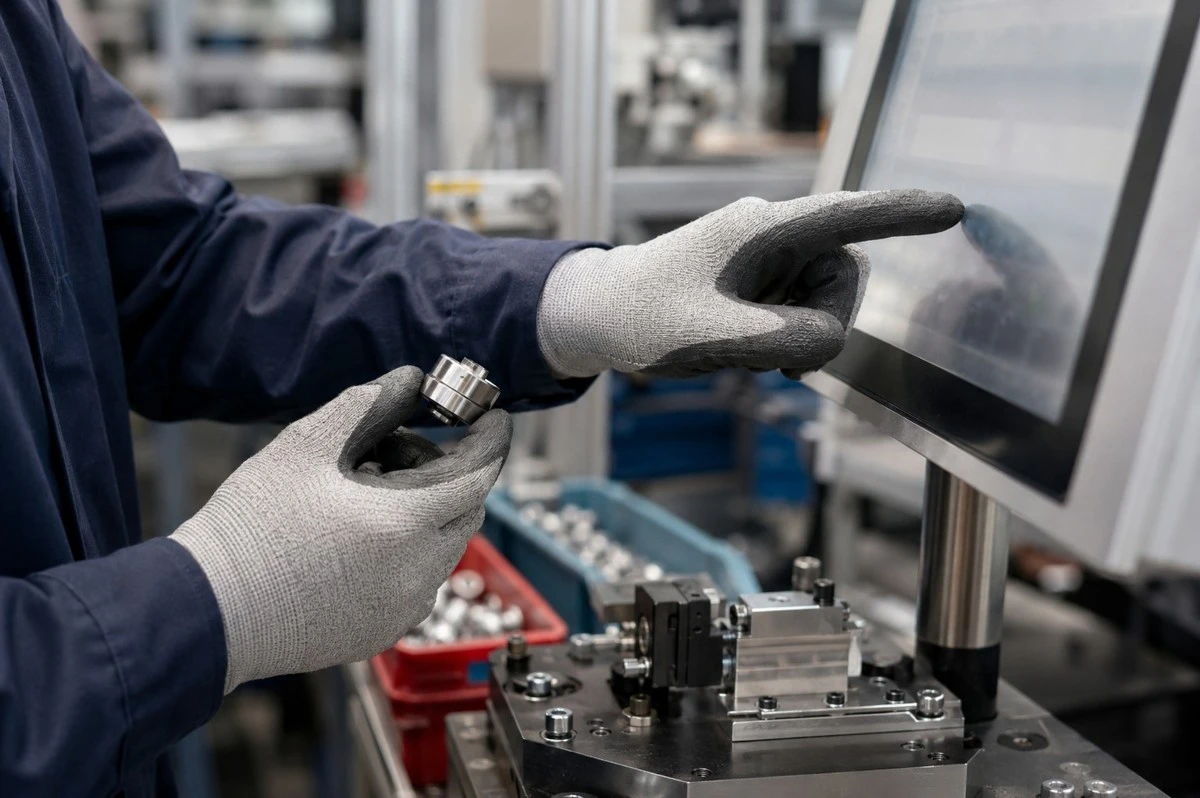
Automated factories have more screens than older production lines. Operators enter quantities, confirm alarms, scan jobs and move between equipment interfaces. It is reasonable for buyers to ask for touchscreen work gloves, but the phrase is often used too loosely.
Performance can vary with the device, screen protector, fingertip construction and coating thickness. A glove that works on one HMI may be unreliable on another. Conductive yarn can improve response, but adding it may also affect the original construction and should be evaluated as part of the finished sample.
For a custom program, the buyer should test the glove on the actual screens used in production. "Touchscreen compatible" should describe a demonstrated function, not a printed icon on the packaging.
A Glove Is Not a Machine Guard
The growth of robotics can improve safety by moving people away from dangerous, repetitive or physically demanding tasks. NIOSH also notes that closer interaction between people and robots can introduce risks such as unexpected contact, caught-between incidents, crushing and trapping.
Hand protection addresses only part of that picture. OSHA's machine-guarding requirements call for guards or other protective methods around points of operation, nip points and rotating parts. A cut-resistant glove cannot replace guarding, an interlock, a safe work procedure or lockout/tagout.
There are also tasks where wearing gloves near rotating machinery can create an entanglement hazard. Glove selection must therefore follow the machine-specific risk assessment rather than a general rule that gloves should always be worn.
This boundary is important. Good PPE guidance explains both where a glove helps and where a different control must come first.
What Buyers Should Observe Before Requesting Samples
The strongest glove brief does not start in a purchasing office. It starts beside the line.
Watch what the operator touches during a complete cycle. Note which fingers do the detailed work, whether parts are dry or oily, where the current glove wears through and when workers remove it. Check whether the same person moves between inspection, material loading and light rework.
Five details usually provide enough direction for a first sample:
- the part or surface being handled;
- the remaining cut, abrasion, puncture or oil hazard;
- the required test standard and performance level;
- the amount of fingertip control and touchscreen use;
- the current glove's most common failure or complaint.
These observations are more useful than asking for a "premium automation glove." They give the manufacturer something that can be translated into liner gauge, yarn, coating, fit and size range.
How Nexprotec Approaches This Type of Project
Nexprotec can develop 13-, 15- and 18-gauge knitted gloves for different levels of handling and precision. Available directions include nylon or HPPE-based liners, PU and nitrile coatings, touchscreen options and custom size grading.
The first sample should answer the working questions before private-label details are finalized. Does the fingertip fit closely enough? Can the operator hold the smallest component without extra effort? Does the coating grip the real part? Is the glove still comfortable after repeated cycles?
Once the construction is approved, logo printing, cuff labels, size colors and packaging can be added. If a specific ANSI/ISEA or EN 388 result is required, testing should be carried out on the final agreed construction rather than an earlier sample that uses different yarn or coating.
Automation is making factories faster and more precise. The glove worn beside the robot has to follow the same direction: less unnecessary bulk, better control and protection that is confirmed rather than assumed.
Developing a glove for automated assembly, component inspection or light industrial handling? Send Nexprotec the application, required standard, current glove and target quantity to discuss a practical sample.
Send Inquiry