

How to Choose Cut Resistant Gloves for Sheet Metal Handling
Nov 24, 2026
Leave a message
Handling sheet metal is one of those jobs where an ordinary work glove may not be enough. Even when a metal sheet looks smooth, its edges can be sharp enough to cause serious hand injuries. Cut edges, stamped parts, burrs and unfinished components all create potential risks during handling and assembly.
For manufacturers, metal fabricators and industrial buyers, choosing the right cut resistant gloves involves more than selecting a high cut protection rating. Grip, glove thickness, abrasion resistance and finger movement all affect how well a glove performs during daily work.
So, what should you look for when sourcing cut resistant gloves for sheet metal handling?
1. Understand the Type of Metal Edge Workers Handle
Not all sheet metal creates the same level of hand protection risk.
The condition of the material is an important part of glove selection.
Smooth sheet metal edges
Some finished metal sheets have relatively clean edges. Workers still need suitable cut protection, but flexibility and handling comfort may be important priorities.
Sharp cut edges
Metal sheets produced by shearing, laser cutting or other fabrication processes may have exposed edges that can cut through unsuitable gloves.
Metal burrs and rough surfaces
Burrs left after punching, stamping or cutting can increase the risk of cuts and accelerate glove wear. A glove that performs well when handling smooth sheets may not last as long when exposed to rough edges.
Small metal components
Workers assembling brackets, stamped parts and other small components often need a closer fit and better fingertip control.
Before selecting gloves, buyers should consider the actual metal thickness, edge condition, handling method and frequency of contact.
A higher cut rating alone does not solve every problem.
2. Choose the Right Cut Protection Level
Cut protection is one of the first specifications industrial buyers check.
In North America, ANSI/ISEA 105 provides a standardized method for evaluating cut resistance. In Europe and other markets using EN 388, gloves are tested under a different system.
Both standards help buyers compare glove performance, but their test methods and rating systems should not be treated as directly interchangeable.
For sheet metal applications, the appropriate protection level depends on the actual workplace risk.
For example:
- Lower-risk handling of finished components may allow the use of lighter cut resistant gloves.
- Handling sharp sheet edges may require a higher level of cut protection.
- Repeated contact with rough or unfinished metal may require additional attention to glove construction and wear resistance.
- For procurement teams, it is important to request actual test reports and confirm the standard and test method used.
- Do not select gloves based only on product descriptions such as "high cut resistance" or "industrial grade."
3. HPPE Liners: A Practical Choice for Metal Fabrication
HPPE is widely used in cut resistant knitted gloves because it offers a useful combination of cut resistance and lightweight construction.
Compared with conventional cotton or nylon work gloves, an appropriately engineered HPPE blend can provide better protection against cuts while maintaining the flexibility needed for many handling tasks.
For sheet metal workers, the liner construction matters just as much as the fiber itself.
Consider the following factors:
Yarn composition
Different HPPE blends may contain nylon, polyester, spandex or other fibers. The composition influences flexibility, comfort, durability and overall glove performance.
Knitting gauge
Gauge affects the knitted structure and glove feel. A finer construction may offer better dexterity, while a heavier construction may be more suitable for certain demanding handling applications.
However, gauge alone does not determine cut protection. Yarn selection and construction also matter.
Glove fit
A glove that is too loose can interfere with handling and increase the risk of snagging. A glove that is too tight may restrict movement and become uncomfortable during extended shifts.
For industrial buyers, the best approach is to evaluate the finished glove rather than relying on fiber names or gauge specifications alone.
4. PU or Nitrile Coating: Which Is Better for Sheet Metal Handling?
The coating is another important consideration because it affects grip, surface contact and resistance to wear.
| Feature | PU Coating | Nitrile Coating |
|---|---|---|
| Dexterity | Often suitable for precise handling | Depends on coating design |
| Grip | Good for many dry applications | Available in different grip textures |
| Flexibility | Generally lightweight and flexible | Varies with formulation and thickness |
| Abrasion resistance | Depends on coating construction | Often selected for demanding handling |
| Typical use | Assembly and light material handling | Fabrication and general industrial handling |
When to consider PU-coated gloves
PU-coated gloves can be a practical option when workers handle relatively clean, dry metal components and need good finger movement.
When to consider nitrile-coated gloves
Nitrile-coated gloves may be worth considering when handling metal parts with rougher surfaces or when additional abrasion resistance and grip are important.
Different nitrile finishes, such as smooth, sandy or micro-foam surfaces, can provide different handling characteristics.
Neither coating is automatically the best choice for every sheet metal operation. The actual surface condition, oil exposure and handling process should guide the selection.
5. Grip and Abrasion Resistance Matter During Daily Handling
Cut resistance is only one part of glove performance.
Workers handling large sheets need to maintain control while lifting, moving and positioning materials.
Poor grip can make handling more difficult, especially when metal surfaces are smooth, dusty or contaminated with oil.
At the same time, repeated contact with sharp edges can wear down the coating and eventually expose the knitted liner.
When evaluating samples, pay attention to:
- Grip on the actual metal surface.
- Coating coverage across the palm and fingertips.
- Abrasion resistance during repeated handling.
- Whether the coating cracks, peels or wears through too quickly.
- Finger flexibility when gripping small components.
For applications involving oily metal surfaces, buyers should specifically evaluate gloves designed and tested for the relevant conditions.
A dry-grip glove should not automatically be assumed to provide reliable grip in oil.
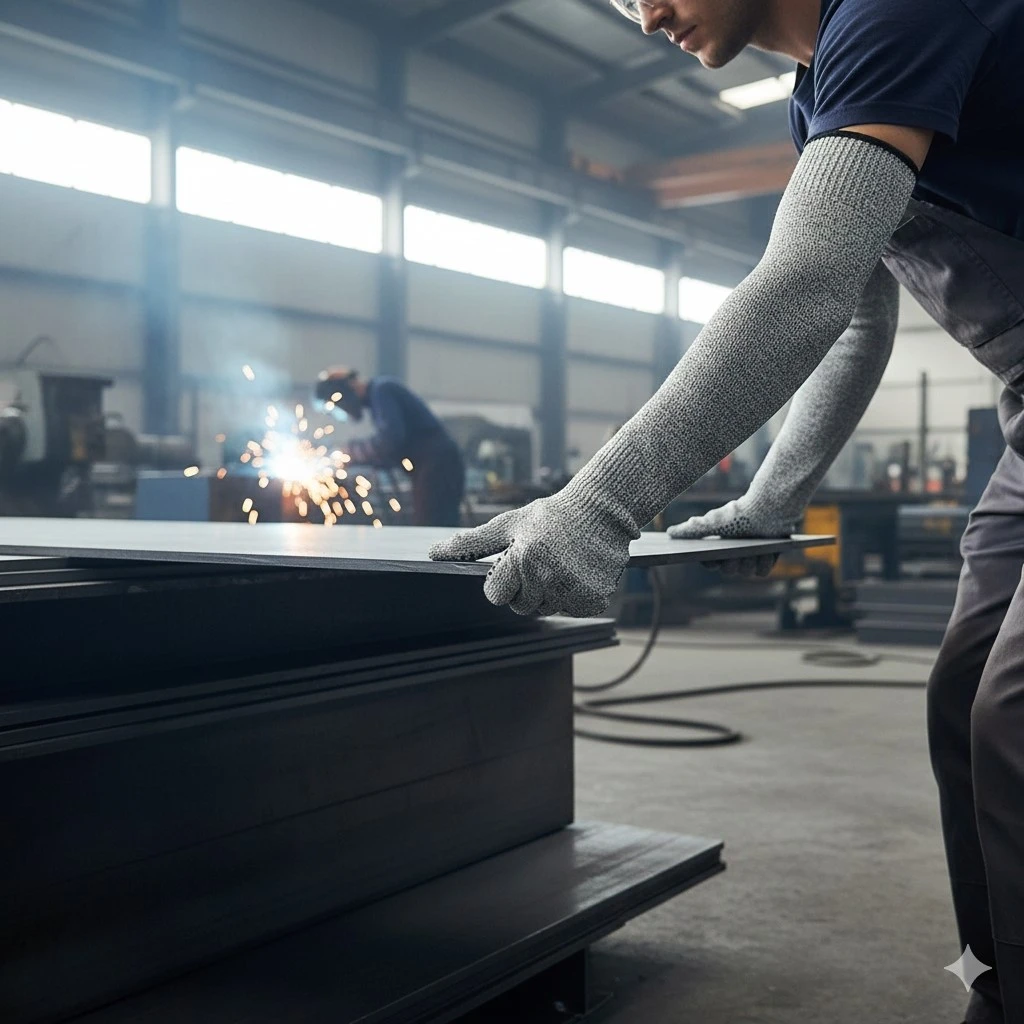
6. Do Workers Need Cut Resistant Sleeves as Well?
In some metal fabrication operations, the risk does not stop at the hands.
Workers may handle large sheets with exposed edges that can contact the wrists and forearms.
In these situations, cut resistant sleeves may be worth considering alongside protective gloves.
The required sleeve length depends on how the material is handled and how much of the arm is exposed.
For example, workers repeatedly lifting or positioning large metal sheets may need additional forearm coverage.
Gloves and sleeves should be evaluated together to ensure that they fit properly and do not leave unnecessary gaps in the areas exposed to sharp edges.
7. What Should Industrial Buyers Check Before Ordering?
For distributors, safety equipment suppliers and metal fabrication companies, sample evaluation is an important step before placing a bulk order.
A practical checklist includes:
- Cut resistance: Confirm the applicable ANSI/ISEA 105 or EN 388 test results.
- Material: Review the HPPE blend and knitted liner construction.
- Coating: Confirm PU or nitrile type, coverage and surface finish.
- Grip: Evaluate performance using the actual materials handled by workers.
- Fit: Check available sizes and finger flexibility.
- Durability: Observe coating wear and liner damage during representative work.
- Documentation: Request technical specifications and relevant test reports.
It is also worth reviewing glove performance after repeated use, rather than evaluating only brand-new samples.
The right glove should meet the workplace requirements while remaining practical for everyday tasks.
8. Custom Cut Resistant Gloves for Metal Fabrication Applications
Different metal fabrication operations may require different glove specifications.
Some buyers prioritize lightweight construction and dexterity, while others need higher cut protection, stronger abrasion resistance or a different coating finish.
NEXPROTEC manufactures HPPE cut resistant knitted gloves with different gauges, protection levels and coating options.
Available customization can include:
- HPPE blended yarn configurations.
- Different knitting gauges.
- PU or nitrile palm coatings.
- Customized colors and cuff designs.
- Multiple sizes and private-label packaging.
For buyers developing their own industrial safety glove range, specifications can be discussed according to the intended application and required performance.
Samples and relevant testing should be reviewed before confirming bulk production.
Frequently Asked Questions
What are the best gloves for handling sharp sheet metal?
The best choice depends on edge sharpness, material thickness, handling frequency and workplace conditions. Cut resistant knitted gloves with suitable PU or nitrile coatings are common options to evaluate.
Are HPPE gloves suitable for metal fabrication?
HPPE-blend gloves can be suitable for many metal fabrication tasks when their tested cut resistance, fit and coating match the application.
Are PU or nitrile gloves better for handling metal sheets?
PU is often considered for lightweight dry handling, while nitrile offers different grip and abrasion options. Actual performance depends on the coating design and working conditions.
Do thicker cut resistant gloves always provide better protection?
No. Thickness alone does not determine cut performance. Fiber composition, yarn construction and test results are also important. Excessive thickness may reduce dexterity.
Can cut resistant gloves protect against all metal cutting hazards?
No. Gloves provide limited protection and must be selected for the specific hazard. They should never be used as a substitute for machine guards, safe work procedures or appropriate engineering controls.
Final Thoughts
Choosing cut resistant gloves for sheet metal handling requires a balance between protection, grip, durability and dexterity.
For metal fabrication companies and industrial distributors, the most effective starting point is to understand the actual material and working conditions before deciding on a glove specification.
At NEXPROTEC, we support OEM and ODM projects for cut resistant knitted gloves, including HPPE liners, different coating options and customized specifications.
Contact our team to discuss your sheet metal handling glove requirements, request product samples and explore suitable options for your market.
NEXPROTEC – Safety Gloves Since 2011.
Send Inquiry